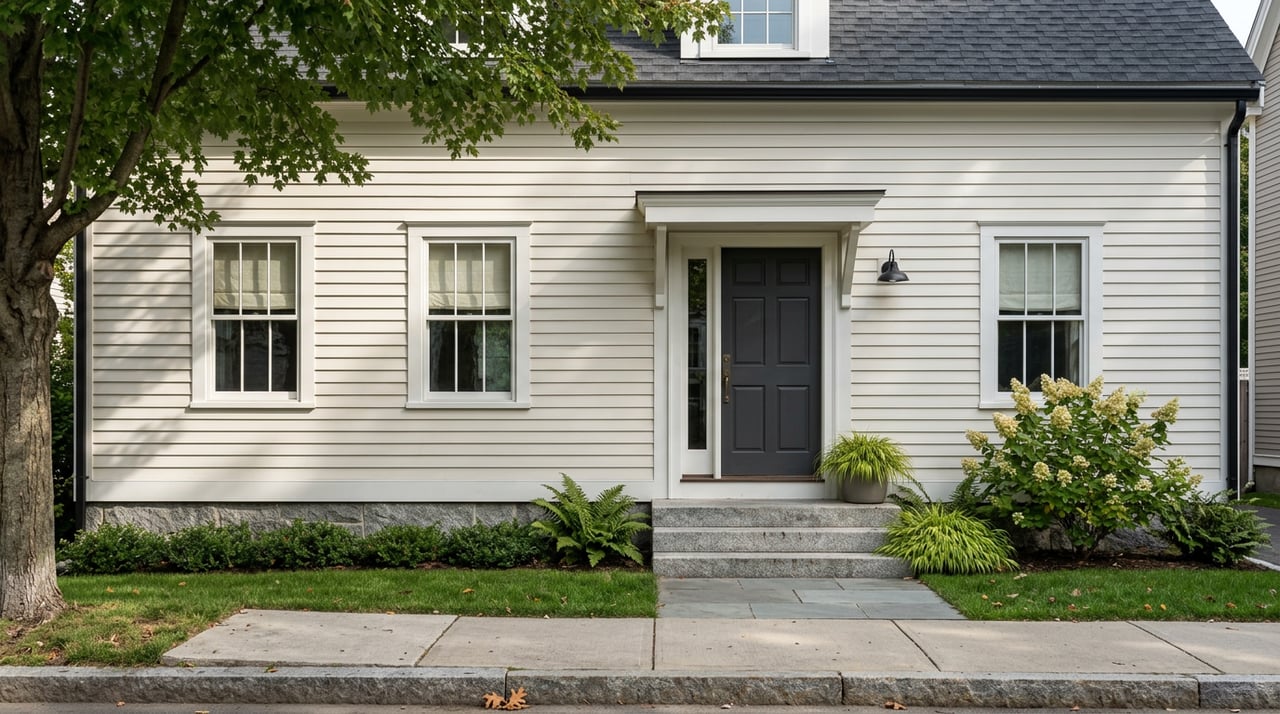
Stand on the outbound platform at Readville station on a weekday afternoon and the two Hyde Parks are visible at once. To the north, the old industrial corridor along Hyde Park Avenue, low warehouses, a WPA-era retaining wall, a CSX freight yard humming behind the fence. To the south and east, a construction crane over Sprague Street, a rendering board zip-tied to a chain-link gate, and the outline of a six-story apartment building where a machine shop used to be.
The buyers I talk to who are comparing Hyde Park to Roslindale or Jamaica Plain almost never see this. They see a median list price around $667K as of July 2026 and a soft year-over-year headline, and they file Hyde Park under "the affordable one." That read is not wrong. It is incomplete. Hyde Park is repricing along a corridor most search portals do not know how to isolate, and the repricing is being driven by a sequence, not a story, that is easy to miss if you are only looking at last month's sold comps.
The thesis, stated plainly
Roughly 600 approved residential units are landing at the southern edge of Hyde Park before the Fairmount Line's frequency upgrade arrives. Supply is showing up first. Service is showing up second. Prices near the corridor are already moving on a price-per-square-foot basis even while the headline median stays soft. If you buy or sell in Hyde Park in the next 18 months without understanding that sequence, you are pricing off the wrong number.
What is actually in the pipeline
The Readville corridor is not one project. It is a cluster, mostly along Hyde Park Avenue and Sprague Street, that individually looks like ordinary infill and collectively looks like a rezoning by accretion.
| Project | Address | Units | Status |
|---|---|---|---|
| Hamilton apartments | 1742 Hyde Park Ave | 42 | ZBA approved May 5, 2026 |
| Geraghty condos | 1702 Hyde Park Ave | 68 (expanded from 44) | Boston Planning approved April 2026 |
| Sprague St complex | Off Sprague Street | 247 | Under construction, nearing completion |
| Residences at Readville Station | Adjacent to Readville MBTA | 279 | Fully permitted, site being marketed |
| River Street infill | 1904 River St | 8 added to existing 16 | ZBA approved May 5, 2026 |
The Hamilton project alone tells you where the neighborhood group and the developer disagree, and where the city landed. The Readville Watch neighborhood group opposed the project on parking grounds; the developer's lawyer countered that "our backyard is the commuter-rail station," and the board unanimously approved variances that included putting multi-family housing in an industrial zone. That is not a one-off. The mainly industrial corridor along Hyde Park Avenue near the train station has, over recent years, slowly become a residential area.
Add in the non-residential piece, because it matters for foot traffic and eventual retail. Readville Yards is transforming an underutilized rail yard into 375,000 square feet of light industrial and office space spread across seven buildings. That is jobs walking distance to the same station.
The service upgrade that has not shown up in prices yet
Here is the piece most buyers miss. Readville is the terminus of the Fairmount Line, and the Fairmount Line is about to change character. Right now it is a commuter rail. Very soon it will operate more like rapid transit.
In December 2023, MBTA Commuter Rail operator Keolis proposed procuring battery electric multiple units and implementing 20-minute headways on the Fairmount Line by 2027; the MBTA board approved the $54 million proposal in July 2024, with new equipment to enter service in early 2028. Stadler was selected in May 2026 to provide seven 4-car trainsets with purchase options for 96 additional cars. The first trainsets are planned to be delivered for testing in Q4 2029.
Today, service runs half-hourly. Since May 2024, Fairmount Line riders in Roxbury, Dorchester, Mattapan, and Hyde Park have been able to catch a train every 30 minutes on weekdays. Going from 30-minute to 20-minute headways on a line that already reaches South Station in roughly half an hour is not a small change. It closes the psychological gap between "commuter rail" and "subway." That is the kind of shift that reprices the walk-shed around a station once buyers internalize it. As of mid-2026, they have not.
The charging infrastructure is being built at Readville, which is why the corridor around the station is worth watching specifically. As of May 2026, a two-track maintenance facility is planned for Readville Yard with possibility of future expansion, along with charging stations for seven BEMUs and an electrical substation. The station is also, and this is easy to forget, a rare three-line node. Readville is served by the MBTA Commuter Rail Fairmount, Franklin/Foxboro, and Providence/Stoughton Lines.
What this does to the headline median
Now the market data starts to make sense.
The citywide backdrop is stable. The Boston housing market enters the second half of 2026 with prices holding firm, inventory loosening modestly, and mortgage rates settling into the mid-6% range. The 30-year fixed-rate mortgage averaged 6.47% on June 18, 2026, down from 6.81% a year earlier.
Hyde Park itself, on the surface, looks quiet. As of July 2026, homes were listed at a median of about $667K according to Movoto's snapshot, and the year-over-year story is mixed depending on which tracker you read.
But look one layer down and the picture changes. Local Hyde Park reporting for the May-July 2026 window shows inventory at 2.16 months, down from 4.88 a year earlier, homes selling in a median of 6.5 days at about 99% of asking, and, most importantly, price per square foot up roughly 33% year-over-year to a $610 median. The reason the headline median looks softer while PPSF is up is a mix effect: a broader mix of smaller and mid-sized homes cleared in 2026 than in the same window in 2025, when a handful of high-end sales pulled the median up.
That gap between median and PPSF is exactly what you would expect in a neighborhood where new, smaller, transit-adjacent units are entering the pipeline while heritage homes trade less frequently. The headline number is a mix artifact. The per-square-foot number is the signal.
Where the friction shows up in transactions
This sequence changes what a buyer or seller has to prepare for, and the friction is real.
- Appraisal comp sets are thin near the corridor. New multi-family construction near the station is not yet reflected in closed sales, so appraisers reach for older comps in different pockets of Hyde Park. Expect appraisal gaps on offers written above the visible comp band, especially for renovated single-families within walking distance of Readville station.
- Small-multi valuation runs on rents that are about to move. Investors underwriting a two- or three-family on Hyde Park Ave or River Street should be pricing rent growth assumptions off the BEMU service date, not off trailing twelve months. Underwrite conservatively for the current schedule and let the frequency upgrade be upside, not thesis.
- Parking variances are being granted. The Hamilton project got approval to build denser than the zoning otherwise allowed, and the argument that carried the day was transit adjacency. If you are buying a nearby single-family expecting the block to stay low-density, read the ZBA decisions on file with the city before you write your offer.
- Off-market activity is a bigger share of the neighborhood than MLS suggests. In a market where inventory ran at roughly 2.16 months of supply as of May 2026, the heritage homes on the larger lots often trade quietly. If you are only watching the portals, you are watching a partial market.
- Land value is close to headline sale value. Recent local reporting puts Hyde Park land values in the $500K to $800K range depending on lot size and location, which means a home selling in the low-$800Ks is trading near land. That has real implications for renovation math and for tear-down risk on adjacent parcels.
For the seller who is already there
If you own in Fairmount Hill, near Cleary Square, or along the Fairmount Avenue side of the neighborhood, none of this argues for waiting. Days on market are short, sale-to-list is tight, and buyer demand as of mid-2026 is running well ahead of 2024 and 2025 at the same point in the calendar. What it argues for is pricing off PPSF and recent condition-adjusted comps rather than off a headline median that a handful of large sales can swing in either direction. The pricing mistake in this market is not aiming too low. It is anchoring to a number that does not describe your block.
For the buyer choosing between neighborhoods
Hyde Park's affordability advantage over Jamaica Plain and much of Roslindale is real and will persist through the pipeline. What the Readville corridor changes is which pockets inside Hyde Park are likeliest to see the tightest price compression as new units deliver and service improves. If your priorities are walk-to-rail, an eventual near-subway schedule, and appreciation potential, the corridor is worth the extra afternoon. If your priorities are yard, quiet, and a mid-century single-family with a driveway, the interior streets remain the value.
Short FAQ
Is the Fairmount frequency upgrade actually funded, or is it a plan? Funded and contracted. The MBTA board approved the $54M Keolis proposal in July 2024, Stadler was selected in May 2026 to build the trainsets, and financing is in place through Rock Rail on a 15-year lease structure. Delivery dates can move, but the commitment is real.
Does more supply near Readville push prices down in the rest of Hyde Park? Not on the evidence so far. The new units are largely rental, largely on former industrial parcels, and largely aimed at renters who would otherwise commute in from further out. The corridor's effect on for-sale single-family prices in Fairmount Hill or Stony Brook is more likely to run through improved retail and transit than through supply competition.
How do I actually verify what is approved near a specific address? Boston Planning maintains project pages for filed and approved developments, and the Zoning Board of Appeal publishes decision records. For any offer within a quarter mile of Readville station, pulling those two files is worth an hour of your time before you sign.
If you are weighing Hyde Park against another close-in Boston neighborhood, or thinking about listing a home within walking distance of the Fairmount Line, Juan Real Estate Group can walk the corridor with you, pull the comps that portals miss, and price the sequence rather than the headline. Let's connect — book a free valuation or consultation.