· By Juan Murray
Smoke and CO Detector Certificate for Massachusetts Home Sales
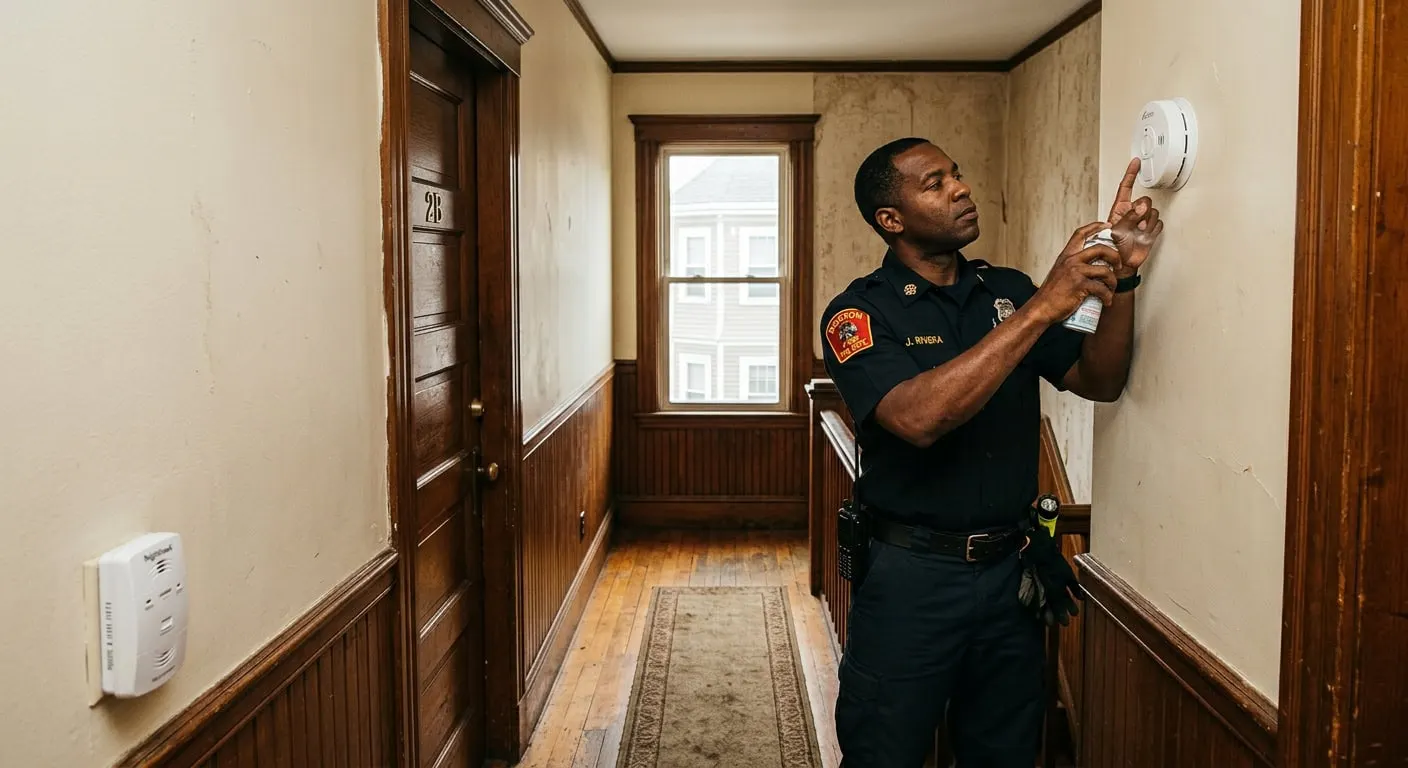
Massachusetts law requires a fire department inspection of smoke and carbon monoxide alarms when a home is sold or transferred. In Boston, the Fire Department asks sellers to apply as soon as the Purchase and Sale Agreement is signed and requires at least 10 business days' notice to schedule. Build that lead time into your closing date.
Does a Massachusetts Home Seller Need a Smoke and CO Certificate?
Yes. The fire department inspection is the requirement that surprises sellers most. Before closing in Boston, Jamaica Plain, Roslindale, Hyde Park, Dorchester, or anywhere else in Massachusetts, the local fire department inspects the home's smoke and carbon monoxide alarms and issues a certificate of compliance. This comes from Massachusetts General Laws Chapter 148, Sections 26F and 26F½. For the rest of what happens between accepting an offer and handing over the keys, see what happens after you accept an offer in Massachusetts. For the closing costs this sits alongside, see how much you'll net selling your home in Boston.
Key Takeaways
- Massachusetts General Laws Chapter 148, Sections 26F and 26F½, require a fire department inspection of smoke and carbon monoxide alarms when a home is sold or transferred.
- Boston requires at least 10 business days' notice and doesn't guarantee an inspection before your closing date, so apply as soon as the Purchase and Sale Agreement is signed.
- A CO certificate is required for every residential dwelling unit, and a smoke certificate for residential properties built before 1975 with 1 to 5 dwelling units.
- In pre-1975 homes, no alarm may be older than 10 years, and smoke alarms within 20 feet of a kitchen or full bathroom must be photoelectric.
- State law caps the inspection fee at $50 for a single-family home, $100 for a two-family, and $150 for buildings of three to six units.
What Does Massachusetts Law Require for Smoke and CO Alarms at Sale?
Section 26F requires the seller to equip a residential property with approved smoke detectors upon sale or transfer, enforced by the head of the fire department. Section 26F½ requires a fire department inspection of carbon monoxide alarms upon sale or transfer of a residential property. According to the Boston Fire Department, a smoke certificate is required for residential properties built before 1975 with 1 to 5 dwelling units, and a CO certificate is required for every residential dwelling unit regardless of age or unit count. Ask the fire department how long a certificate stays valid if your closing date moves.
How Far Ahead Do You Need to Schedule the Boston Inspection?
Boston requires a minimum of 10 business days' notice, not counting weekends or holidays. Appointments go first-come, first-served, and the city notes there is no guarantee an inspection will happen before your closing date. The Fire Department's advice is to apply as soon as you sign the Purchase and Sale Agreement. Apply through the Fire Prevention Portal on boston.gov ("Apply for a permit," then "Smoke and Carbon Monoxide Detector Inspection"); payment is made online before an appointment is scheduled. Rescheduling requires 48 hours' notice and cancellations 24 hours. Questions go to smokedetector.bfd@boston.gov or 617-343-3628.
What Does the Inspector Check in a Pre-1975 Boston Home?
Alarm type, power source and age, and placement. Boston's Smoke/CO Alarm Reference Sheet lays out the rules by construction date. For homes built before 1975 that haven't been substantially modified:
Detector type. Smoke alarms within 20 feet of a kitchen or full bathroom must be photoelectric. Elsewhere, they must have photoelectric sensing and may also have ionization (a dual-sensor alarm). Combination smoke and CO alarms must have a voice feature.
Power and age. Hardwired, interconnected alarms are allowed. If the alarms are not hardwired, they must be sealed lithium-battery units, and no alarm may be older than 10 years. The manufacture date is printed on the back.
Placement. Smoke and CO alarms are required in the basement, on every habitable level, in a habitable finished attic, and outside each sleeping area (within 10 feet of the bedroom door). A smoke alarm is also required at the base of the stairs. Smoke alarms must be ceiling mounted. Buildings with 3 or more units have added requirements for common hallways and stairways.
Homes built or substantially modified after 1975 follow the building code in effect at the time, which can require hardwired, interconnected alarms with battery backup. If your home had a permitted renovation and you're unsure which rules apply, call the Fire Prevention Division before the inspection.
How Much Does a Smoke and CO Inspection Cost?
State law caps the fee for these inspections at $50 for a single-family home or single dwelling unit, $100 for a two-family, $150 for buildings of three to six units, and $500 for buildings with more than six units. When the smoke and CO inspections are done at the same time, there's no additional fee for the CO inspection. If the home fails, you replace what's needed and arrange a re-inspection.
What Happens to the Certificate at Closing?
Once the home passes, the fire department issues the certificate. Get a copy to the closing attorney well before the closing date and confirm they have it.
FAQ
Is the smoke and CO certificate required for all Massachusetts home sales?
The CO inspection applies to every residential sale. According to the Boston Fire Department, the smoke certificate is required for residential properties built before 1975 with 1 to 5 dwelling units; properties built after January 1, 1975 with 6 or more units are exempt.
Who is responsible for getting the certificate: the buyer or the seller?
The seller. Section 26F places the duty to equip the home with smoke detectors on the seller, and Boston's guidance says sellers must obtain the certificates. Confirm any different arrangement in writing in the Purchase and Sale Agreement.
What happens if my home fails the fire department inspection?
The inspector notes what failed. Common problems are alarms older than 10 years, the wrong type near a kitchen or bathroom, missing alarms on a level or outside a bedroom, and dead units. Correct the issues and arrange a re-inspection. Lead time before the closing date is what keeps a failed first inspection from becoming a delay.
How far in advance should I schedule the Boston Fire Department inspection?
At least 10 business days, not counting weekends or holidays. The Fire Department recommends applying as soon as the Purchase and Sale Agreement is signed.
Does the smoke and CO requirement apply to condos in Massachusetts?
Yes for CO: Boston requires a CO certificate for every residential dwelling unit. Whether a smoke certificate is needed depends on the building's age and number of units, so check with the Fire Department for your building.
The bottom line: apply for your smoke and CO inspection as soon as the Purchase and Sale Agreement is signed, and get the certificate to the closing attorney well before closing.
Sources
- Massachusetts General Laws c. 148, § 26F: https://malegislature.gov/Laws/GeneralLaws/PartI/TitleXX/Chapter148/Section26F
- Massachusetts General Laws c. 148, § 26F½: https://malegislature.gov/Laws/GeneralLaws/PartI/TitleXX/Chapter148/Section26F1~2
- Massachusetts General Laws c. 148, § 10A (inspection fees): https://malegislature.gov/Laws/GeneralLaws/PartI/TitleXX/Chapter148/Section10A
- City of Boston, Smoke and Carbon Monoxide Detector Inspections: https://www.boston.gov/departments/fire-prevention/smoke-and-carbon-monoxide-detector-inspections
- Boston Fire Department, Smoke/CO Alarm Reference Sheet: https://www.boston.gov/sites/default/files/file/2023/08/Smoke-CarbonReferenceSheet_0.pdf
- Boston Fire Department, Smoke and Carbon Monoxide Detector Requirements Based on Construction Year: https://www.boston.gov/sites/default/files/file/2023/03/Smoke%20Carbon%20Requirements-word_0%20%282%29.pdf
Have questions? Let's connect.
About Juan Murray
Juan Murray is a Boston broker associate with more than 30 years of experience helping buyers, sellers, and investors across Greater Boston, personally leading every transaction from the first conversation through closing.
RE/MAX Real Estate Center · (978) 581-0801
Equal Housing Opportunity. Juan Murray is licensed as a Broker in Massachusetts, regulated by the Massachusetts Board of Registration of Real Estate Brokers and Salespersons. This article is general information only and does not constitute legal, tax, or financial advice. Confirm your specific costs and obligations with your closing agent, tax advisor, or lender.