· By Juan Murray
What Will Fail a Home Insurance Inspection in Massachusetts
There's no single pass-or-fail standard for a home insurance inspection in Massachusetts: each carrier sets its own underwriting rules. Conditions that commonly draw questions include an aging or damaged roof, knob and tube or other older wiring, signs of water intrusion or foundation movement, missing smoke and carbon monoxide alarms, unsafe decks or stairs, and heating oil tanks. What one insurer declines, another may cover with conditions, so the answer depends on the carrier.
What will fail a home insurance inspection in Massachusetts?
There's no single standard, but an aging or damaged roof, knob and tube or other older wiring, water intrusion, missing smoke and CO alarms, unsafe decks or stairs, and heating oil tanks commonly draw questions. Each carrier decides whether to decline, require repairs, or change terms. If you own or are about to buy a triple-decker in Roxbury, a two-family in Dorchester, or a single-family in Roslindale, the homeowners insurance conversation matters because a buyer's lender requires proof of insurance before it funds the loan. If a carrier declines or attaches conditions late in the process, the closing date can slip. For how old wiring specifically can affect a sale, see why knob and tube wiring can stop your Boston home sale. For a broader pre-listing repair checklist, see what to fix before selling your Boston home.
Key Takeaways
- Each Massachusetts carrier sets its own underwriting rules, so what one insurer declines, another may cover with conditions.
- Roof condition is one of the first things many carriers ask about.
- Massachusetts insurers writing policies on one- to four-unit homes must make heating oil leak coverage available (M.G.L. c.175 §4D).
- If a buyer can't get coverage in the voluntary market, the Massachusetts FAIR Plan provides basic property insurance on eligible property.
- Test every smoke and CO alarm, document your roof and wiring, and clear gutters before an inspection.
How does roof condition affect a home insurance inspection?
Roof condition is one of the first things many carriers ask about, because water intrusion can lead to costly damage. Age, missing or curling shingles, damaged flashing around chimneys and vents, sagging, and active leaks can all draw questions. Carriers differ on how much roof age they accept and whether they respond with a decline, a repair requirement, or different coverage terms, so ask the insurer directly rather than relying on a rule of thumb.
What categories do home insurers ask about?
Roof, electrical, plumbing, foundation and water, safety features, and yard hazards. These are categories many carriers look at. Which ones matter, and how much, varies by insurer and property. Repair costs vary widely too, so get written quotes from licensed contractors for anything flagged.
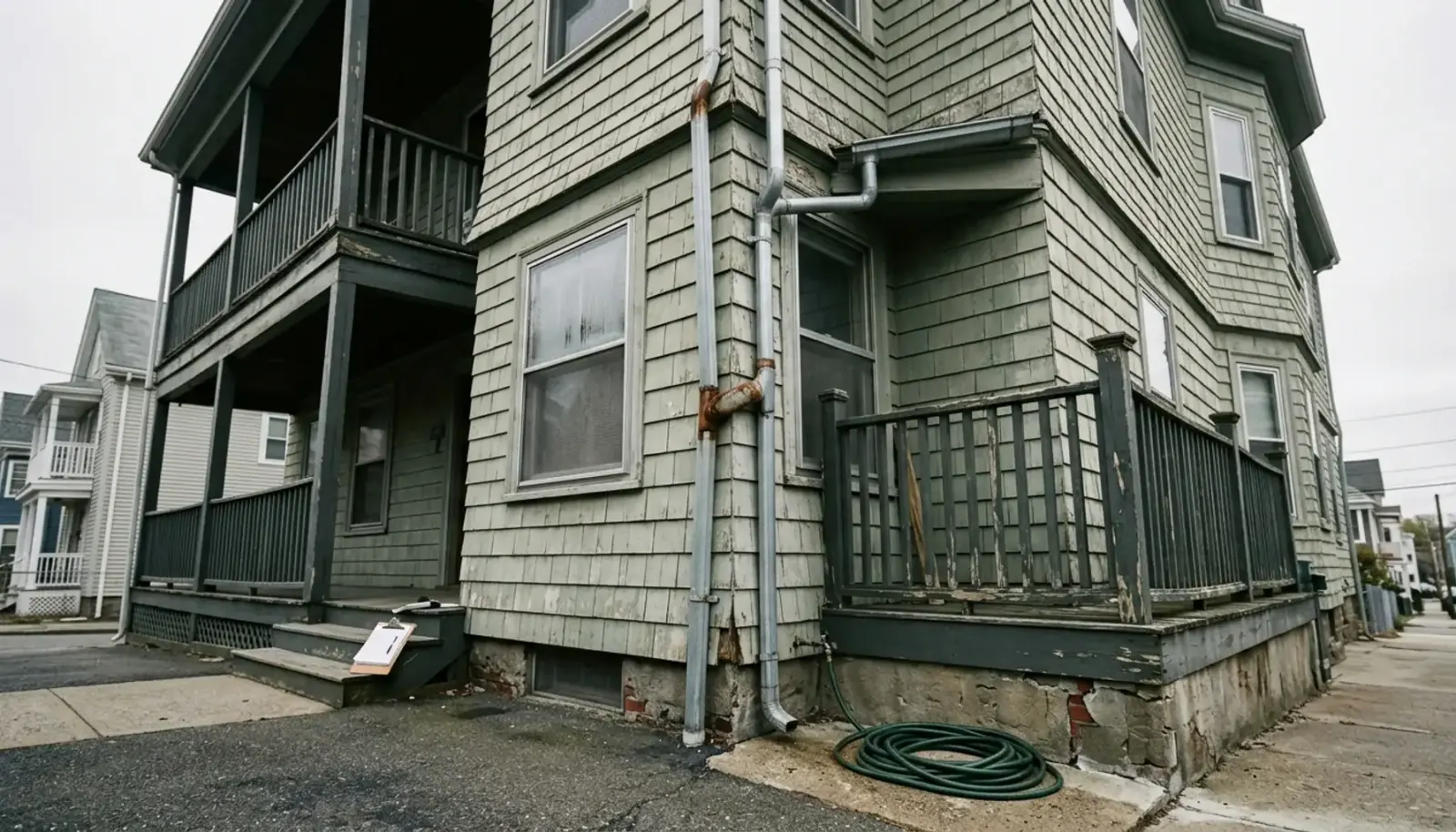
Roof: age, missing shingles, damaged flashing, leaks. Electrical: knob and tube or aluminum branch wiring, outdated panels, exposed wiring. Plumbing: older pipe materials such as galvanized steel or polybutylene, and active leaks. Foundation and water: wide or active cracks, uneven floors, water intrusion. Safety features: missing smoke or CO alarms, decks or stairs without proper railings. Yard hazards: overhanging trees, clogged gutters, poor drainage.
How do oil tanks affect home insurance in older Boston homes?
Heating oil tanks come up often in older Boston-area homes. Massachusetts law requires insurers writing homeowners policies on one- to four-unit homes to make coverage available for heating oil leaks, with minimum limits set in the statute (M.G.L. c.175 §4D). An insurer can require proof that the oil system meets the upgrade requirements of M.G.L. c.148 §38J before issuing that coverage. If the property has an oil tank, buried or above ground, have its age, location, and condition documented. Juan's guide to underground oil tanks for Boston sellers goes further.
New England freeze-thaw cycles and snow loads also put wear on roofs, gutters, and masonry, so documentation of maintenance and repairs helps whatever the carrier asks.
How do Massachusetts home inspection rules relate to insurance inspections?
A home insurance inspection is separate from a buyer's home inspection. Under M.G.L. c.143 §101 and 760 CMR 74.00, for most sales of one- to four-unit homes and condominiums where the first Offer to Purchase or Purchase and Sale Agreement is signed after October 15, 2025, a seller can't condition acceptance of an offer on the buyer waiving or limiting a home inspection. That means more buyers will have an inspector's report in hand, and conditions like old wiring or roof wear are more likely to come up before the insurance quote rather than after.
What Happens If a Carrier Won't Write the Policy?
Outcomes vary by carrier. An insurer may require a repair before or after binding, offer coverage with an exclusion or different terms, or decline the policy. If a buyer can't get coverage in the voluntary market, the Massachusetts FAIR Plan, run by the Massachusetts Property Insurance Underwriting Association (MPIUA), provides basic property insurance on eligible property for applicants who couldn't get coverage elsewhere. Terms and premiums differ from a standard policy, and the buyer should confirm their lender accepts it.
What should Boston homeowners check before an insurance inspection?
Start with alarms, the roof, and wiring.
- Test every smoke and carbon monoxide alarm and replace units past the manufacturer's replacement date. If you're selling, you'll also need a fire department certificate; see the smoke and CO certificate guide.
- Get your roof's age and condition documented by a licensed roofer if it's getting older.
- Confirm your wiring type. If knob and tube wiring is suspected, have a licensed electrician evaluate it and document findings in writing.
- Inspect decks and exterior stairs for soft wood, missing railings, and loose steps.
- Clear gutters and trim overhanging tree branches near the roofline.
- Check your basement and attic for moisture or mold, and address any active leaks.
- Confirm plumbing material, and keep records and permits for any prior replacement.
- Review foundation walls for cracks, and consult a structural engineer if you see signs of active movement. See selling a Boston home with foundation issues.
- If the property has an oil tank, buried or above ground, document its age and condition.
FAQ
Can I refuse a home insurance inspection?
You can, but the carrier decides whether to bind or renew a policy without one, and many will not. Ask your insurance agent what the carrier requires before declining.
How often do insurance companies inspect homes?
It varies by carrier. Some inspect at a new application, some after a claim, and some review properties periodically. Ask your agent what your carrier's practice is.
Which fixes does an insurer require?
It depends on the carrier and the finding. Life-safety and water-related issues, such as missing alarms, active roof leaks, exposed wiring, and structural movement, are more likely to draw a requirement than cosmetic items like worn paint or dated fixtures.
How long does a home insurance inspection take?
It depends on the carrier, the inspection type, and the size of the property. A multi-family building may take longer than a single-family because there's more to look at. Ask the carrier or inspector what to expect.
Do I have to disclose knob and tube wiring when selling my Boston home?
Don't misrepresent it. Massachusetts doesn't require most sellers to complete a disclosure form, but a seller who is asked directly should answer honestly, and real estate licensees have an affirmative obligation to disclose known material defects (254 CMR 3.00(13)(c)). The wiring is also likely to surface in the buyer's inspection.
Can homeowners dispute a failed insurance inspection?
You can ask the carrier which specific finding triggered the decision, request a reinspection after repairs, and provide documentation from a licensed contractor. Your insurance agent can also check whether other carriers would write the policy.
The bottom line: there's no single pass-or-fail standard, so document your roof, wiring, alarms, and any oil tank before the inspection and ask the carrier what it requires.
Sources
- M.G.L. c.175 §4D (heating oil release coverage): https://malegislature.gov/Laws/GeneralLaws/PartI/TitleXXII/Chapter175/Section4D
- Massachusetts Property Insurance Underwriting Association (Massachusetts FAIR Plan): https://www.mpiua.com/
- M.G.L. c.143 §101 (home inspection waivers): https://malegislature.gov/Laws/GeneralLaws/PartI/TitleXX/Chapter143/Section101
- 760 CMR 74.04 (exemptions, October 15, 2025 date): https://www.law.cornell.edu/regulations/massachusetts/760-CMR-74-04
- 254 CMR 3.00 (Massachusetts real estate licensee conduct): https://www.law.cornell.edu/regulations/massachusetts/254-CMR-SS-3.00
Have questions? Let's connect.
About Juan Murray
Juan Murray is a Boston broker associate with more than 30 years of experience helping buyers, sellers, and investors across Greater Boston, personally leading every transaction from the first conversation through closing.
RE/MAX Real Estate Center · (978) 581-0801
Equal Housing Opportunity. Juan Murray is licensed as a Broker in Massachusetts, regulated by the Massachusetts Board of Registration of Real Estate Brokers and Salespersons. This article is general information only and does not constitute legal, tax, or financial advice. Confirm your specific costs and obligations with your closing agent, tax advisor, or lender.